
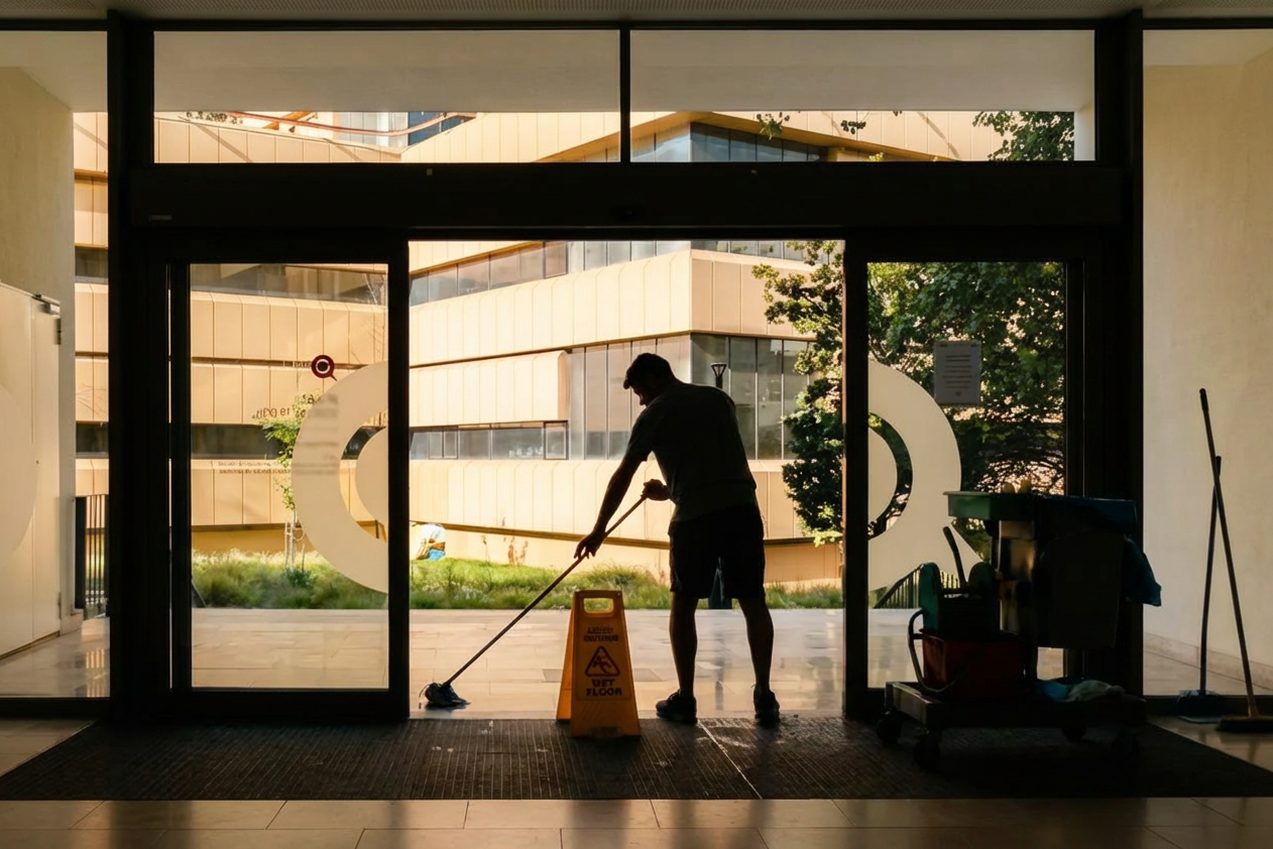

Three things predict whether a commercial cleaning company will still look good in month six: verified proof of business liability insurance straight from its insurer, cleaners on its own payroll hired under a written background-check policy, and a written scope with a fixed inspection cadence. Everything else — tenure claims, green badges, glossy proposals — is decoration.
Price is a signal too: recurring office cleaning in the Netherlands runs €2.50–6.00 per square metre per month according to De Haan FD Groep's 2025 rate guide, so a bid far below that band is your first red flag, not your best offer. This guide covers the nine vetting questions, the four documents to demand, and the five contract clauses that protect you. Short on time? Jump straight to the nine questions.
What questions should you ask a commercial cleaning company?
Ask nine questions covering staffing, insurance, background checks, absence coverage, scope, inspections, fix windows, key handling, and exit terms. Weak vendors answer four of them vaguely; strong vendors answer all nine in writing without flinching.
- Who will actually clean our building — your employees or subcontractors? A good answer sounds like "our own staff, on our payroll under the Dutch cleaning collective agreement (CAO), and we'll confirm that in writing." Subcontracting layers are where training, insurance, and accountability quietly evaporate.
- Can you send proof of business liability insurance, with current dates and the cover amount listed, before we sign? A good answer: "our insurer will issue it within a day, and fresh proof reaches you automatically at every renewal." Hesitation here usually means the policy is thinner than the brochure.
- What is your background-check and onboarding process for anyone entering our space? A good answer names the screening provider, the timing ("cleared before their first shift"), and what the first two weeks of training cover.
- Who covers the shift when our regular cleaner is sick or quits? A good answer describes a bench: a trained floater who has already walked your building. "We'll send someone" means your office becomes the training ground.
- What exactly is in scope — and what costs extra? A good answer arrives as an itemized task list by area and frequency, plus a printed add-on sheet. "General cleaning of all areas" is not a scope; it is a future argument.
- How do you inspect the work, and how often will we see the results? A good answer includes a named supervisor, a scheduled walkthrough at least monthly, and a scorecard that lands in your inbox — not "call us if something's wrong."
- What happens when something is missed? A good answer commits to a fix window measured in hours — flagged by 9 a.m., corrected the same business day — plus a credit if the same item misses twice.
- How are our keys, codes, and alarm procedures handled? A good answer: a signed key log, access codes issued per person rather than shared, and a written deactivation step for anyone who leaves the company.
- What are your exit terms if this doesn't work out? A good answer is 30-day written notice with no penalty after the trial period. Vendors confident in their service don't need a 12-month lock to keep you.
There is a tenth, unscored move for the walkthrough itself: glance at the spray bottles on the demo cart or in a reference building's closet. A trained crew labels every bottle with the product name and dilution ratio; mystery bottles mean no chemical training and no safety-data compliance — two things you are about to demand on paper.
Ask us the hard questions
Send the list as-is — we'll answer every one in writing with our quote.
Get a quote See how we run office cleaningDocuments to demand before you sign
Four documents separate a real operation from improvisation: current proof of business liability insurance, safety data sheets for every chemical used on site, the written background-check policy, and proof of the staffing model. A vendor who produces all four within 48 hours runs a real back office.
- Proof of business liability insurance — issued directly by the vendor's insurer or broker, with current dates and the cover amount listed — and a KVK number on the quote that matches the company actually signing your contract.
- Safety data sheets (SDS) — one per product the crew brings into your building. Ask where the SDS binder will live; "in your janitor closet, with a dilution chart on the door" is the answer of a vendor who has done this before.
- Background-check policy — the written document, not a verbal assurance: what gets screened, what disqualifies, and whether re-checks happen after hiring.
- Staffing-model proof — a plain written statement that the people in your building are the vendor's own employees, or full disclosure of exactly which work is subcontracted and to whom.
The renewal detail most buyers miss
A photocopied proof of insurance shows the policy existed the day it was printed — nothing more. Make the contract require fresh, insurer-issued proof at every renewal, sent to you automatically, so a lapsed policy cannot hide mid-contract. It costs the vendor nothing to arrange, which is exactly why a refusal tells you so much.
What are the red flags when hiring a cleaning service?
The expensive red flags are a bid far below the others, insurance talk without paper, and scope language too vague to inspect against. Each flag has a specific consequence — and a ten-second test that exposes it.
| Red flag | What it costs you | The ten-second test |
|---|---|---|
| A bid far below the other quotes | Misclassified labour or missing insurance — you inherit the liability, and quality collapses once the introductory effort fades | Ask how many crew-hours per visit the price assumes, then do the wage math |
| "We're fully insured," but no proof of insurance ever arrives | You find out at claim time that you were never covered | Ask for insurer-issued proof with the cover amount listed; a real policy makes this a five-minute task |
| A fixed quote with no walkthrough for a larger space | A lowball number now, "that's extra" invoices later | Offer the walkthrough and watch: pros take it, guessers decline it |
| Scope written as "general cleaning of all areas" | Every complaint becomes a negotiation, because nothing is specific enough to inspect | Ask for tasks itemized by area and frequency in the contract appendix |
| No named supervisor or inspection schedule | Quality becomes complaint-driven — you end up working as their QA department | Ask who inspects, how often, and what report you receive |
| A large upfront payment or an auto-renewing long lock-in | You fund their cash flow while losing your only leverage | Ask for a 30-day exit clause and watch the reaction |
The wage math is the sharpest test on the list. A registered cleaning company in the Netherlands charges €25–35 per hour according to Trustoo's price guide — a rate that has to carry CAO wages, payroll taxes, insurance, supplies, equipment, and supervision. And that floor is still rising: cleaning pay went up 3% plus €0.10–0.25 per hour on 1 January 2026 under the RAS CAO, with the new collective accord adding roughly 6% more over 2026–28. A quote that implies your space gets cleaned for less than the labour alone is not efficiency; it is a vendor planning to cut hours, corners, or legal obligations.
What a registered cleaning company charges per hour in the Netherlands (Trustoo price guide). Divide a suspiciously low bid by the crew-hours your space realistically needs — if the result sits below this band, the quote is subsidized by something you don't want to own.
Before you compare the bids against each other, benchmark them against the market. Our guide to what businesses actually pay for office cleaning in 2026 breaks down the going rates by building size, visit frequency, and pricing model.
What should be included in a commercial cleaning contract?
Five clauses do the protecting: an itemized scope, a 30-day exit, a price-escalation cap, a written service remedy, and insurance maintenance. A contract missing two or more of these was drafted to protect the vendor — not you.
| Clause | Why it matters | A fair version |
|---|---|---|
| Scope of work | Vague scope turns every dispute into a matter of opinion | Tasks itemized by area and frequency, attached as a contract appendix |
| Termination | A 12-month lock removes your only real leverage | 30-day written notice, no penalty, after an initial 60–90-day trial |
| Price escalation | Quiet annual increases compound faster than anyone notices | Increases capped at once per year, with 60 days' written notice |
| Service remedy | Without a fix window, "we'll get to it" counts as compliance | Missed items corrected within one business day; a credit when the same item misses twice |
| Insurance maintenance | Proof of insurance shows the past, not the future | Coverage held for the full term, with fresh insurer-issued proof sent automatically at every renewal |
Read the auto-renewal line twice. A fair contract may renew automatically, but only alongside a standing 30-day exit; auto-renewal paired with a fixed term is a trap with a calendar. Make the contract say who supplies what, too — vendor-provided equipment and chemicals, with consumables like paper and bin liners itemized separately, so restocking never quietly becomes your office manager's job.
How to run a fair trial period
Run a 60–90-day trial scored against the written scope, with a weekly walkthrough for the first month. A fair trial tests the vendor's system, not one cleaner's good week.

Keep the scoring dumb and repeatable: the same ten items on every walk, pass or fail — entrance glass, high-touch points, restroom restock, bin liners, floor edges, and corners. Two operator checks earn a permanent place on that list. Run a finger along the top of a door frame or the fire-extinguisher cabinet: high dusting is the first task that quietly drops off a rushed route. And watch the order of operations once — a professional crew works high to low and finishes floors on the way out, while a crew that mops first is re-doing its own work on your clock.
Score the trend, not the first visit. Opening visits run long while the crew learns the building; what matters is whether week four beats week one and whether flagged items stay fixed. Match the inspection rhythm to your cleaning cadence as well — a twice-a-week office doesn't need daily walkthroughs, and our guide to how often an office should be cleaned shows what each cadence should be delivering between inspections.
When should you switch cleaning vendors?
Switch when quality has become complaint-driven: the same miss reported twice in a month, new crew faces every week, or invoices creeping without a scope conversation. Those patterns are systemic, and a replacement supervisor rarely fixes them.
- The same items keep missing after being flagged — the fix window exists on paper only.
- Crew turnover every few weeks, so nobody ever learns your building's quirks.
- Invoice lines that grew without any scope change you agreed to.
- A supervisor you only meet after complaints, never on a schedule.
- Consumables running out — paper, soap, liners — until tracking them becomes your job.
Time the switch like an operator: run the new vendor's trial before your current contract's exit date so the building is never uncovered, and hold the keys-and-codes handover to the same written protocol you demanded in question eight. Ask the incoming vendor one stress question while you're at it — what happens after hours when a pipe bursts on a Friday night? Response speed under pressure reveals more than a year of Tuesday visits, which is why we publish our emergency cleaning response as its own service, with crews reachable outside office hours.
And here is the transparency test that ends most shortlists: tell each finalist you want every answer in writing. We call the nine questions above "questions we're happy to be asked" — send them with your quote request and our answers come back in writing alongside the price. A vendor who resists writing things down is telling you exactly how the relationship will go.
Frequently asked questions
How do I know if a cleaning company is properly insured?
Ask for proof of business liability insurance issued by the vendor's insurer or broker, with current dates and the cover amount listed, and make the contract require fresh proof at every renewal so a lapsed policy cannot hide mid-contract. Check the company's KVK registration too — the number belongs on every quote and invoice it sends you.
How many quotes should you get before choosing a cleaning company?
Three is the working number: enough to see the market band, few enough to compare properly. Give each vendor the same floor plan, the same frequency, and the same task list so the bids are apples to apples — then question the outlier, in either direction, before you celebrate it.
Is the cheapest commercial cleaning quote ever the right choice?
Occasionally — when the vendor can show the same crew-hours, insurance, and on-payroll staffing as the higher bids and is simply hungrier for the contract. Usually, a much lower price means fewer hours in your building or misclassified labour. Ask what the quote assumes in crew-hours per visit; the answer settles it fast.
What should be included in a commercial cleaning contract?
An itemized scope by area and frequency, the visit schedule, a named supervisor with an inspection cadence, a fix window for missed items, insurance-maintenance language, a price-escalation cap, and a 30-day exit clause after the trial period. If supplies are included, the contract should state who stocks and pays for consumables.
How long should a commercial cleaning contract run?
Start with a 60–90-day trial, then run month to month or annually with a 30-day out. Confident vendors accept short exit terms because retention is their job, not the contract's. Be wary of 12-month locks paired with auto-renewal — they exist to protect the vendor from their own service.
One meeting of hard questions costs you an hour; the wrong vendor costs you a year of complaint emails and a messy exit. Shortlist three companies, demand the four documents, score the trial — and if you'd rather start with answers already in writing, see how our office cleaning program for businesses is built: written scope, named supervisor, inspection cadence, and an exit clause we don't make you fight for.